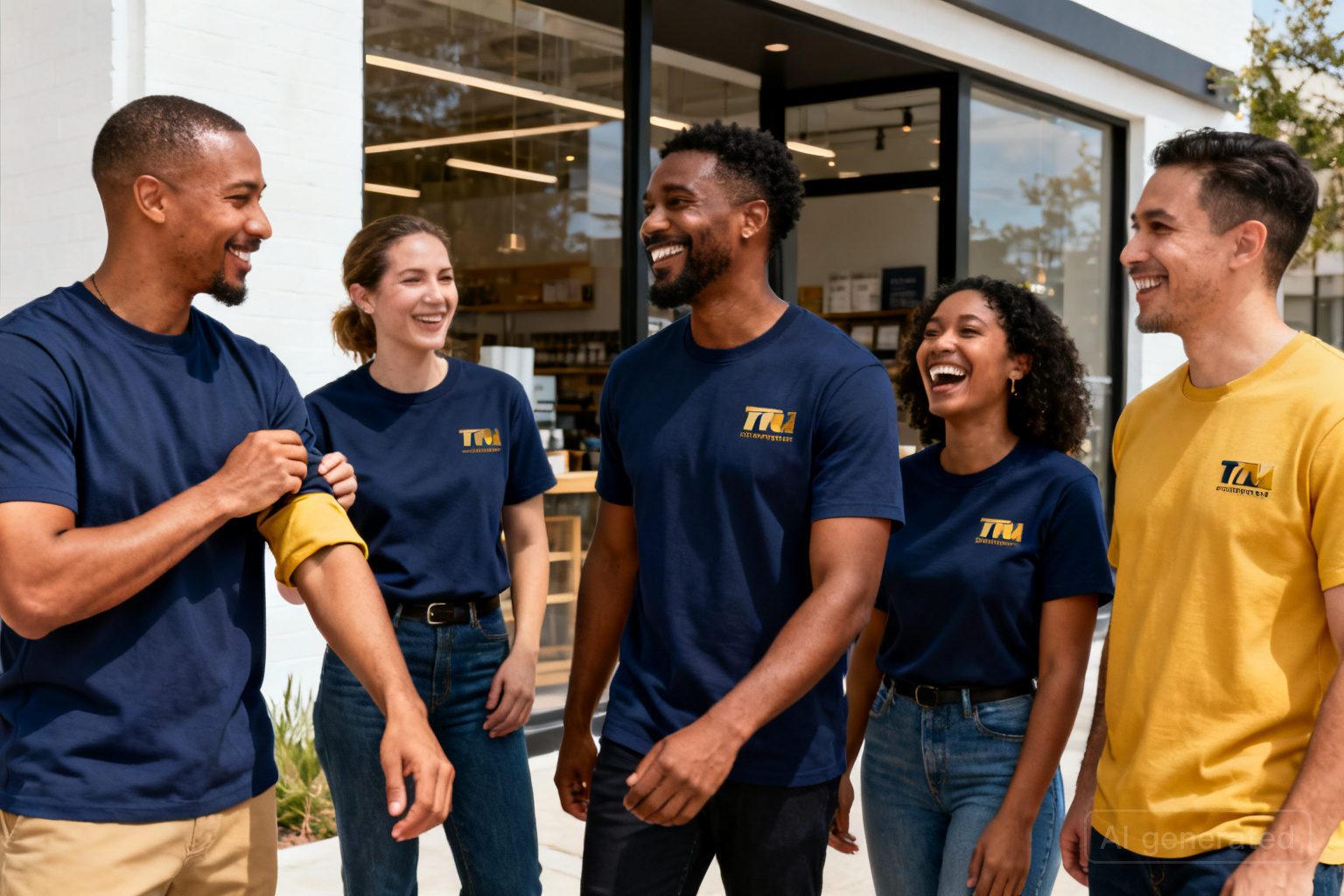
Custom t-shirts are one of the most effective ways to build brand awareness, unite a team, and create lasting impressions at events. Whether you're outfitting your staff, promoting a local event, or creating merchandise for a cause, a well-designed custom t-shirt works harder than almost any other marketing tool.
This guide walks you through every step: from design principles that actually work, to choosing the right printing method and fabric, to ordering the right quantity for your needs. By the end, you'll know exactly how to turn a blank shirt into a brand asset.
Key Takeaways
- Start with a clear design brief—know your audience, message, and where the shirt will be worn
- Choose between screen printing, direct-to-garment, and heat transfer based on design complexity and quantity
- Select fabric weight and fit that match your brand voice and intended use
- Order enough to make an impact, but not so much that you're stuck with overstock
- Integrate custom t-shirts into a broader branding strategy alongside business cards, flyers, and signage
What Are Custom T-Shirts and Why Do Small Businesses Order Them?
A custom t-shirt is a blank garment printed or embroidered with your design—logo, message, artwork, or photo. For small businesses, they serve multiple purposes: employee uniforms that build team identity, giveaways that keep your brand top-of-mind, event merchandise that generates buzz, and walking billboards that spread your message across the Houston metro and beyond.
The real power is in repetition. Someone wearing your t-shirt sees your logo dozens of times a day. Their friends, family, and coworkers see it too. That's brand reinforcement that paid ads struggle to match.
How Do You Design a Custom T-Shirt That Actually Works?
Start by answering three questions: Who will wear this? What do you want them to remember? Where will they wear it? A t-shirt for a construction crew needs a different design than one for a nonprofit gala.
Good t-shirt design is simple, readable at arm's length, and works in one or two colors (or full color, depending on your printing method). Avoid tiny text, overly complex illustrations, and designs that look better on a computer than on a real person's chest.
If design isn't your strength, that's exactly what Graphic & Brand Design services are for. A professional designer will ensure your logo translates perfectly to fabric, colors print accurately, and the placement flatters the wearer.
Sketch your layout on paper first: Where does the logo go? Chest, back, sleeve? How large? What's the supporting text, if any? This rough planning saves time and prevents expensive reprints.
Keep your primary design element between 3–6 inches wide. Too small and it disappears; too large and it looks overwhelming on a shirt.
What Printing Methods Work Best for Custom T-Shirts?
Three main methods dominate: screen printing, direct-to-garment (DTG), and heat transfer. Each has strengths depending on your design, quantity, and budget.
Screen printing is ideal for bold, solid-color designs and large quantities. It's durable, vibrant, and cost-effective per unit when you're ordering dozens or more. The setup takes time, so smaller orders aren't economical.
Direct-to-garment (DTG) works like a t-shirt printer. It handles photorealistic images, gradients, and unlimited colors in small quantities—even one-offs. Quality is excellent, but per-unit costs are higher than screen printing.
Heat transfer (including DTF Heat Transfers) bridges the gap. You print a design onto a special transfer, then press it onto the shirt. It's flexible, fast, and works for small to medium runs with detailed artwork.
- Screen printing: Bold, durable, economical at scale
- Direct-to-garment: Photorealistic detail, small quantities welcome
- Heat transfer: Fast turnaround, detailed designs, medium runs
If you're ordering 50+ shirts with a simple 2-color logo, screen printing wins on value. For photographic designs or orders under 20, DTG or heat transfer is smarter.
How Do You Choose the Right Fabric and Fit for Your Brand?
Fabric weight matters. Lightweight cotton (4.0–5.0 oz) feels soft but can look cheap and shrink unpredictably. Mid-weight (5.5–6.0 oz) is the sweet spot for most brands—durable, comfortable, and professional. Heavy-weight (6.5+ oz) looks premium but costs more and can feel stiff.
Fit shapes perception. A fitted cut signals modern, fashion-forward; a classic unisex cut says approachable and inclusive. Oversized fits work for streetwear and youth-focused brands. Consider your audience and the context where the shirt will be worn.
Fiber content also influences durability and feel. 100% cotton is classic and breathable. Cotton-poly blends (usually 50/50 or 65/35) resist shrinking and wrinkles. Performance fabrics (polyester blends) wick moisture and suit athletic or outdoor wear.
Order a sample shirt in your chosen fabric before committing to a full run. Seeing and wearing it firsthand catches surprises that photos miss.
What's the Difference Between Screen Printing and Direct-to-Garment?
The core difference is process and scalability. Screen printing uses mesh screens and ink to push color through onto fabric—one color at a time, one shirt at a time. Setup involves creating screens, which takes time and cost upfront. But once screens are made, printing each additional shirt is fast and cheap.
Direct-to-garment uses inkjet technology to spray color directly onto the fabric, like a regular printer. No screen setup. Each shirt is printed individually. This makes DTG perfect for small orders, custom designs, and photorealistic artwork. The trade-off: per-unit cost stays high even for large runs.
For a Houston business ordering 100 shirts with a two-color logo, screen printing is more economical. For 10 shirts with a detailed photo, DTG is the only practical choice. For something in between—say, 30 shirts with a multi-color design—heat transfer might offer the best balance.
Ask your printer to show you samples of both methods with your exact design. Seeing the difference on actual fabric beats any explanation.
How Many T-Shirts Should You Order?
Order based on realistic need, not wishful thinking. A common mistake is overordering because the per-unit cost drops at higher quantities. You end up with boxes of unsold shirts taking up space.
For a team uniform, count your staff plus 10–15% for growth, replacements, and new hires. For an event, estimate attendance and assume 60–70% of attendees will take a shirt. For merchandise or giveaways, start with what you can realistically distribute in six months.
If you're uncertain, start smaller. You can always reorder the same design (assuming screens or files are saved). A second run of 50 shirts costs less per unit than the first 50, but you still avoid the risk of massive overstock.
Keep your design files and screen information organized. If a design sells well, you'll want to reorder quickly without hunting for files or recreating screens.
How Do Custom T-Shirts Fit Into a Larger Branding Strategy?
Custom t-shirts don't exist in isolation. They're most powerful when they're part of a cohesive brand identity that includes your logo, colors, messaging, and visual style.
Start with Graphic & Brand Design to establish a strong logo and brand kit. That same logo goes on your business cards, flyers, signage, and yes, t-shirts. Consistency across touchpoints builds recognition. Someone who sees your logo on a t-shirt, then on a business card they pick up at a networking event, then on a flyer at a local coffee shop, remembers you.
T-shirts also pair well with other promotional items. A t-shirt at an event, plus a business card to follow up, plus a custom flyer describing your service—that's a multi-channel impression that sticks.
Think of t-shirts as part of your brand ecosystem, not a standalone product. They amplify your other marketing efforts and create touchpoints that last longer than most ads.
Choose a consistent color palette across all branded items. If your t-shirt is navy and gold, your business cards and flyers should echo those colors.
What's the Timeline for Ordering Custom T-Shirts in the Houston Area?
Timeline depends on method, quantity, and current demand. As a family-owned print shop in Cypress, TX, 53Printers offers fast local turnaround—you're not waiting weeks for shipment from across the country.
Screen printing typically requires time for screen setup plus printing days. Direct-to-garment is faster for small runs since there's no setup. Heat transfer falls somewhere in between. Exact timing depends on complexity and current queue, so it's worth asking when you're ready to order.
The best approach: plan ahead. Know when you need the shirts (event date, team launch, giveaway distribution) and communicate that timeline upfront. Rush orders are possible, but planning ahead removes stress and often saves money.
Submit your final design at least two weeks before your target date. This buffer accounts for proofing, revisions, and production without panic.
Where Should You Order Custom T-Shirts?
Look for a printer who understands your brand, asks good questions about your design and use case, and delivers quality consistently. A local shop like 53Printers means you can see samples, discuss your vision face-to-face, and get fast turnaround without shipping delays.
When you're ready to order, get a free quote. Bring your design (or a rough sketch if you're still developing it), let them know your quantity and timeline, and they'll walk you through options for fabric, printing method, and pricing.
Good printers also keep files on record, making reorders seamless. If your t-shirt design becomes a staple of your brand, that institutional knowledge saves you time and money on future runs.
Ask about bulk discounts and reorder pricing. If you plan to order t-shirts regularly, understanding the pricing structure helps you budget and plan ahead.
Frequently Asked Questions
Can I order just 10 custom t-shirts, or do I need a minimum order?+
Minimums vary by printing method. Screen printing usually requires 25–50 units because of screen setup costs. Direct-to-garment has no practical minimum—you can order 1 or 100. Heat transfer typically allows small runs of 10–20. When you're ready to order, ask about minimums for your specific design and printing method.
What file format should I provide for my t-shirt design?+
Most printers prefer vector files (AI, EPS, PDF) for screen printing, as they scale without quality loss. For direct-to-garment and heat transfer, high-resolution raster files (JPG, PNG at 300 DPI) work well. If you don't have design files, a professional designer can create them—or ask your printer what they prefer before you start designing.
Can I use a photo on a custom t-shirt?+
Yes, but the printing method matters. Direct-to-garment handles photorealistic images beautifully. Screen printing works best with simplified, high-contrast photos (not detailed portraits). Heat transfer can reproduce photos well. Discuss your photo with your printer—they'll advise whether it needs adjustment for the method you choose.
How do I prevent my custom t-shirts from shrinking after washing?+
Choose a higher-quality fabric (mid-weight 5.5–6.0 oz cotton or cotton-poly blend) and ask about pre-shrunk blanks. Most professional printers use pre-shrunk shirts. Instruct wearers to wash in cool water and tumble-dry low. Some shrinkage is normal with 100% cotton, but quality blanks and proper care minimize it.
Should I go with screen printing or direct-to-garment for my order?+
Screen printing is more economical for 50+ units with simple designs (1–4 colors). Direct-to-garment is better for small quantities (under 25) or designs with photos and unlimited colors. If you're unsure, describe your design and quantity to your printer—they'll recommend the best method and explain the trade-offs.
Can I order custom t-shirts with my logo if I only have a low-resolution image?+
Low-resolution logos can be cleaned up or redrawn by a designer, which adds cost and time. Ideally, provide a vector file or a high-quality original. If you don't have either, a professional designer can recreate your logo properly—that's a smart investment if you plan to use it on multiple products (t-shirts, business cards, flyers, signage).
How long do custom t-shirts last with regular wear and washing?+
Quality matters. Mid-weight, pre-shrunk blanks with professional printing typically last 50–100+ washes before noticeable fading. Proper care (cool water, low heat drying, turning inside-out) extends life. Screen printing tends to be more durable than heat transfer over many washes, though modern heat transfer methods are quite durable too.
Ready to Order Custom T-Shirts for Your Houston Business?
Whether you're outfitting a team, creating event merchandise, or building brand awareness, custom t-shirts work. Get a free quote and let's bring your design to life.
Get a Free Quote